Here’s a stat that explains why so many businesses feel disappointed after “doing video”:
More than 70% of businesses that invest in video stop within six months, not because video doesn’t work — but because they don’t know what to do after the footage is delivered (Wyzowl).
That’s the part no one warns you about.
Most business owners don’t fail at video because they chose the wrong camera or lighting.They fail because they hired the wrong type of help.
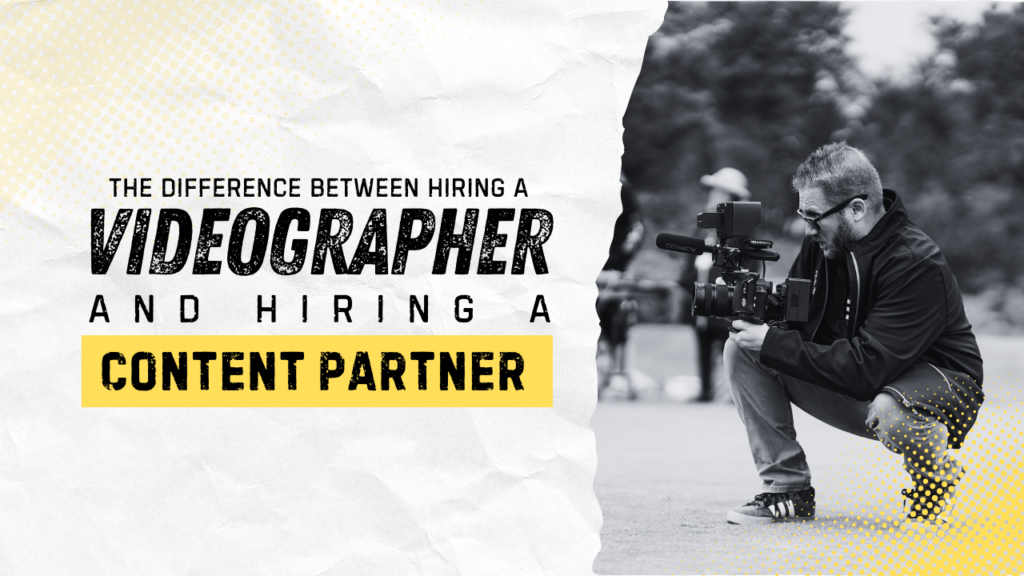
They hired a videographer.
What they actually needed was a content partner.
On the surface, they look like the same thing
This is where confusion starts.
Both show up with cameras.
Both record footage.
Both promise “professional video.”
From the outside, it feels interchangeable.
It’s not.
The difference shows up after the shoot — when real life kicks back in and content has to actually work for your business.
What hiring a videographer usually looks like
A videographer’s job is straightforward:
- show up
- film what you ask for
- deliver footage
- move on
That’s not a knock. That’s the role.
The problem is what happens next.
Most business owners are left with:
- raw files
- edited videos with no plan
- no idea how often to post
- no clarity on what to say next
So the content sits.
Or it gets posted once.
Or it gets posted inconsistently until momentum dies.
Why this feels frustrating for business owners
From the business owner’s perspective, it feels like this:
“I paid for video… why isn’t this working?”
The issue isn’t the quality.
It’s the lack of direction.
Videographers capture moments.
They don’t build systems.
And marketing without a system doesn’t compound.
What a content partner actually does differently
A content partner doesn’t start with cameras.
They start with:
- your business goals
- your audience
- what you need this content to do
Then they reverse-engineer everything else.
A content partner thinks about:
- what topics matter most
- how often you should show up
- how one recording becomes many assets
- how content fits into your broader marketing
The camera is just a tool.
Not the product.
The biggest difference: responsibility
Here’s the line most people miss:
A videographer is responsible for the footage.
A content partner is responsible for the outcome.
That changes everything.
When responsibility ends at delivery, success is optional.
When responsibility includes consistency and visibility, execution matters.
That’s the difference business owners feel almost immediately.
Why videographer-led projects often stall
We see this pattern constantly.
A business hires a videographer.
They do a shoot.
They get excited.
They post a few videos.
Then:
- posting slows
- ideas dry up
- editing becomes a bottleneck
- content feels disjointed
Eventually, it stops altogether.
Not because video didn’t work.
Because no one owned the process.
Why content partners think in batches, not shoots
Videographers think in projects.
Content partners think in systems.
That’s why batching is central to content partnerships.
Instead of asking:
“What video do you want to shoot?”
A content partner asks:
“How much content do you want done so you don’t have to think about this for months?”
That shift alone changes how business owners experience content creation.
Why this matters even more in Windsor-Essex
Local markets don’t reward one-off efforts.
They reward:
- repetition
- familiarity
- consistency
Posting a great video once doesn’t build trust here. Showing up steadily does.
That’s why one-off videography almost always underperforms locally.
It creates spikes. Not presence.
The illusion of saving money
Many business owners choose a videographer because it feels cheaper.
And on paper, it is.
But here’s the real cost:
- unused footage
- stalled momentum
- restarting every few months
- paying again to “try something new”
Cheap execution that doesn’t get used is expensive.
A content partner costs more upfront — and saves money over time by eliminating waste.
Why “we’ll handle the rest” rarely works
Another common scenario:
A videographer delivers footage and says, “You can just post it however you want.”
That sounds flexible. It’s actually abandonment.
Most business owners don’t want to become content strategists, editors, and schedulers on top of running their business.
They want content handled.
When execution gets pushed back onto the owner, consistency dies quietly.
What business owners actually want (but don’t say out loud)
Most business owners want:
- to stay visible
- without thinking about content daily
- without managing another workflow
- without wondering if it’s working
They want marketing off their plate, not half-off.
That’s why content partnerships exist.
Why studios fit naturally into content partnerships
Studios don’t matter when you’re just filming.
They matter when you’re systemizing.
A studio environment:
- removes distractions
- creates focus
- allows multiple pieces to be recorded efficiently
Videographers can work anywhere. Content partners choose environments that maximize output.
That’s a subtle but important difference.
What happens when businesses switch from videographer to partner
This is usually the turning point.
Businesses notice:
- content actually gets posted
- messaging becomes clearer
- leads reference specific videos
- consistency stops being a struggle
The work didn’t increase. The friction disappeared.
That’s the difference.
Why this decision shapes your growth ceiling
Video isn’t the goal.
Visibility is.
Trust is.
Growth is.
If video is treated as a project, it ends. If video is treated as a system, it compounds.
The type of help you hire determines which path you’re on.
The honest comparison
Hiring a videographer gets you footage. Hiring a content partner gets you momentum.
One solves a moment. The other solves a problem.
Final thought
If you’ve tried video before and felt underwhelmed, it’s worth asking:
Did I hire someone to film — or someone to make content actually work?
That distinction changes outcomes more than any camera ever will.
And once you experience content handled end-to-end, going back to one-off video rarely makes sense.