Here’s a stat that usually sounds exaggerated until people experience it themselves:
Businesses that batch content in focused sessions create 4–6× more usable content than those recording casually over time (HubSpot).
Most business owners don’t believe that at first.
They assume:
- they won’t have enough to say
- they’ll run out of energy
- it’ll feel awkward after a few videos
And that assumption is exactly why they keep underestimating what’s possible.
Why most people drastically underestimate their own content
Here’s the truth no one tells business owners:
You talk about your business all day already.
You answer questions.
You explain your process.
You repeat the same advice.
You correct the same misconceptions.
The difference is that none of it gets captured.
So when someone says, “You can create months of content in one half-day,” it sounds unrealistic.
Not because it’s wrong.
Because you’ve never seen your knowledge organized properly.
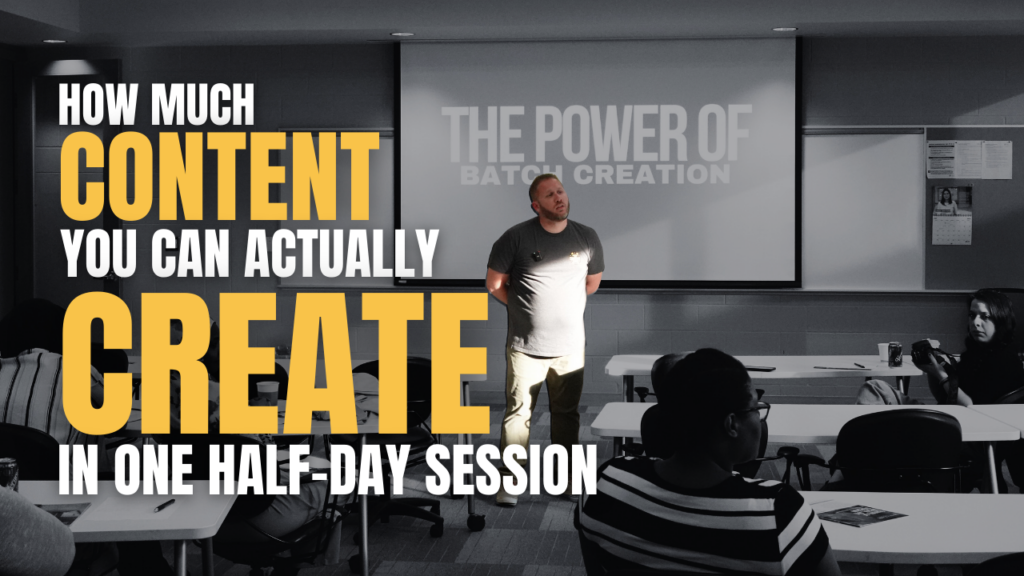
What a half-day session actually looks like (in real life)
A half-day content session isn’t rushed chaos.
It’s structured focus.
Typically, it looks like this:
- a clear plan before you ever hit record
- short, focused recordings (not long speeches)
- momentum built through repetition
- no stopping to edit or perfect
You’re not trying to create masterpieces.
You’re documenting expertise.
That’s a very different mindset — and it changes everything.
The biggest mistake people make before recording
Most business owners think they need:
- scripts
- perfect wording
- “content ideas”
They don’t.
What they actually need is:
- prompts
- direction
- someone keeping things moving
When people over-prepare, they tighten up.
When they under-prepare, they ramble.
The sweet spot is guided conversation.
That’s where volume shows up naturally.
What kind of content actually gets created
This surprises people the most.
In a single half-day session, it’s common to capture:
- short educational videos
- FAQ-style explanations
- myth-busting content
- behind-the-scenes insights
- positioning content
Not because you’re trying to do everything.
Because once you start talking clearly, topics stack quickly.
One answer turns into three clips.
One explanation becomes five usable pieces.
That’s how content multiplies.
Why energy isn’t the limiting factor people think it is
Most people worry they’ll be exhausted after a few videos.
In reality, the opposite usually happens.
Once momentum kicks in:
- confidence increases
- answers flow faster
- hesitation drops
Energy drains when you stop and start.
It builds when you stay in motion.
That’s why batching works better than casual recording spread across weeks.
Why environment changes output dramatically
Trying to batch content at home, between meetings, is where most attempts fail.
Distractions kill momentum.
Emails.
Phones.
People popping in.
A focused environment removes all of that.
Not because it’s fancy.
Because it creates a boundary.
When business owners step into a space designed for content, they switch modes.
That shift alone often doubles output.
Why half-day sessions outperform full-day marathons
More time doesn’t always mean more output.
Long sessions lead to:
- overthinking
- diminishing energy
- unnecessary perfectionism
Half-day sessions work because they:
- force focus
- prevent burnout
- keep delivery sharp
It’s enough time to get meaningful volume without pushing past the point of clarity.
What stops people from hitting high output
There are three common blockers:
- trying to “sound impressive”
- worrying about mistakes
- stopping to judge each clip
None of those help.
High-output sessions work when:
- you speak like you do to clients
- you accept that not every clip is perfect
- someone else handles what gets used
That separation between creation and judgment is critical.
Why editing and posting shouldn’t be part of the session
This is where DIY attempts fall apart.
Recording is one job.
Editing and posting are completely different jobs.
Trying to do all three at once slows everything down.
High-output sessions work because:
- recording stays recording
- everything else happens later
That’s how one half-day turns into months of content instead of a handful of posts.
What most Windsor-Essex business owners notice afterward
After a proper session, most people say the same things:
“I didn’t realize I had that much to say.”
“That felt way easier than expected.”
“I finally understand how this is supposed to work.”
The overwhelm disappears because the unknown disappears.
Content stops feeling endless.
It becomes manageable.
Why this changes how people think about marketing
Once business owners experience this, something shifts.
They stop seeing content as:
- a daily chore
- a constant stress
- a never-ending obligation
And start seeing it as:
- a quarterly activity
- a system
- something they can actually stay on top of
That mindset change is often more valuable than the content itself.
Where done-for-you support makes the difference
High output only matters if content actually gets used.
That’s why the best results come when:
- someone else handles editing
- someone else handles scheduling
- someone else ensures consistency
Your role becomes:
- show up
- share expertise
- leave
That’s leverage.
The real takeaway
If you believe you “don’t have enough content,” you’re probably wrong.
You just haven’t seen your knowledge captured properly yet.
A half-day session doesn’t magically create expertise.
It reveals what was already there.
And once you experience that, content stops feeling scarce — and starts feeling abundant.
That shift alone is why most business owners never go back to ad-hoc content creation.
Final thought
If content still feels like something you’re constantly behind on, it’s worth asking:
Am I underestimating what focused time and the right system could actually produce?
Most people are.
And that realization is usually the moment everything changes.